
The Dessert Paradox: When Being Under-Challenged Kills Results.
25 February 2026
Topic: System Efficiency
In the Scrumkitchen, a phenomenon regularly emerges that is often underestimated in classical organizational consulting: failure due to supposed simplicity. While teams master complex architectures, they paradoxically stumble over the dessert – a parable of the misallocation of resources in high-performance phases.
The Illusion of Control
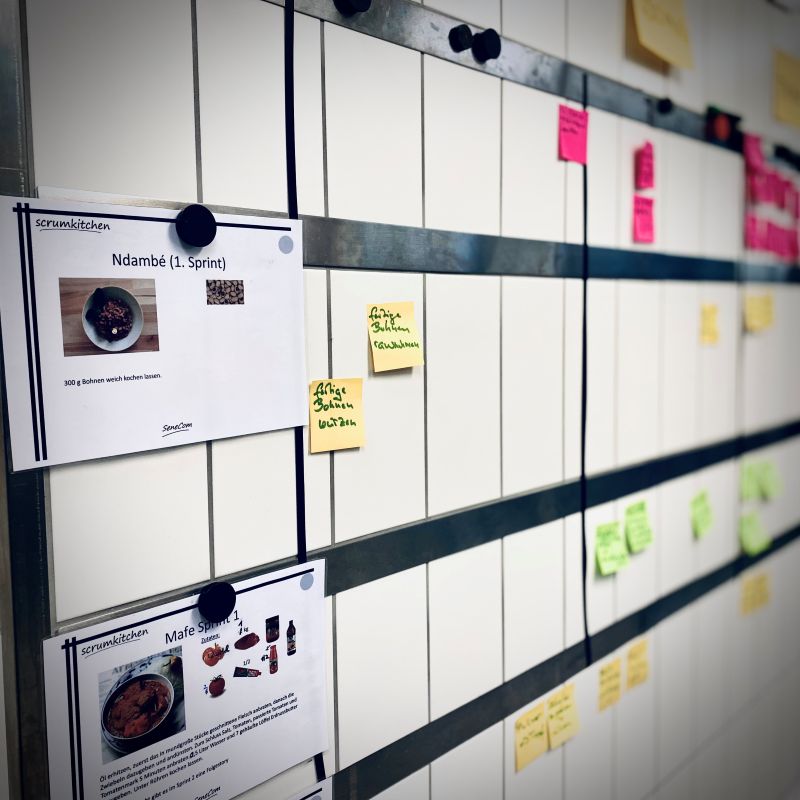
In my Scrum Cooking workshops, I act in the role of the Product Owner. In one instance, the team decided on its own to skip the Planning and Dailies. Their reasoning: “The tasks are too simple; we’ll keep them in our heads.” Since my task distribution system had assigned this team a mathematically light workload, the risk seemed low. Capacity and competence were high – a classic high-performance scenario.
Too Simple, Yet Non-Existent
The result: the main courses were ready on time, but the dessert was completely missing. By deliberately sacrificing the Sprint Backlog, I, as the Product Owner, lost oversight of the User Stories and their progress. Without these artifacts, there is no lateral leadership at eye level—only guesswork. The lack of structure did not lead to speed, but to a blind spot in coordination.
Systemic Diagnosis: Why “Simple” is Dangerous
-
Structural Erosion: When tasks appear simple, methodology is the first thing to be sacrificed. This is the illusion of superiority.
-
Loss of Transparency: Without a representation on the board, failure remains invisible. You only notice an increment is missing when the guest is facing an empty plate.
-
Dysfunctional Lateral Leadership: Leadership without data points is flying blind. When the team refuses transparency, it deprives leadership of the basis for timely feedback.
From the Stove to Daily Work
In the Agile Leadership Lab, we use these exact scenarios to reflect the impact of leadership and feedback in real-time. Experience for yourself how a loss of structure influences lateral leadership – and how you can counteract this through clarity.